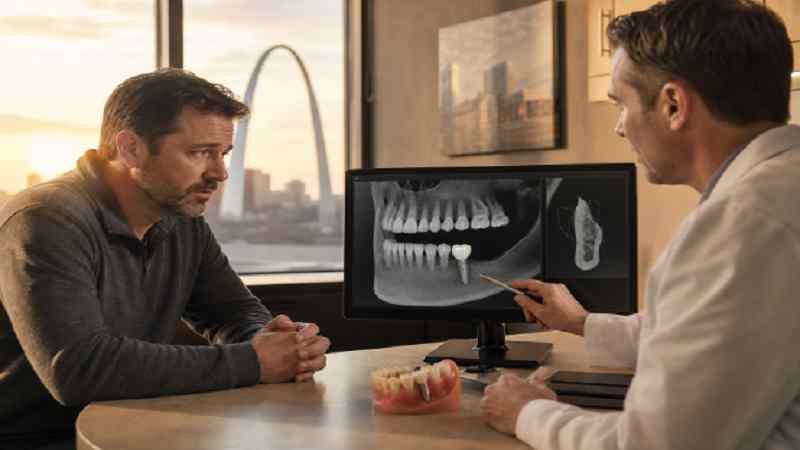
A loose dental implant, persistent bleeding, swelling, pain, or instability should receive immediate professional attention. While dental implants have a high success rate of up to 95%, complications like infection and peri-implantitis may occur. Proper care and treatment of early warning signs are crucial for long-term success. This guide compares four dental practices in St. Louis, emphasizing their ability to address implant failures through services such as implant removal and advanced imaging, while advocating for the preservation of healthy natural teeth.
1. New You Smile — St. Louis, Missouri
New You Smile takes the top position because it directly addresses the problem many patients are actually searching for: a loose, infected, painful, or failed implant. Its dedicated dental implant solution St. Louis, MO page explains that treatment can involve evaluation, X-rays, peri-implantitis care, bone grafting, removal, and replacement planning rather than treating every implant problem as a routine replacement case.
That focused pathway matters because implant failure can involve multiple stages. New You Smile describes seven potential contributors to complications, including excess force, improper angle or location, an unadjusted bite, chronic grinding, poor hygiene, trauma, and systemic disease. It also outlines two removal approaches—piezoelectric bone removal and reverse torque—with a stated emphasis on preserving as much natural bone as possible for future treatment.
- Dedicated service information for failing dental implants and peri-implantitis.
- Seven listed mechanical, hygiene-related, and health-related complication factors.
- Both nonsurgical and surgical treatment pathways are described before replacement is considered.
- Two stated implant-removal techniques are designed around bone preservation.
- Two listed doctors: Dr. James Fetsch and Dr. Amber Meyers.
- One St. Louis location at 10004 Kennerly Road, Suite 330A.
- Separate published phone numbers for new and current patients.
- Additional services that include bone grafting, IV sedation, implant-supported dentures, and full-arch implant options.
For patients wondering, “Can a failed implant be removed and replaced?” New You Smile offers the clearest publicly described answer among the providers reviewed. It does not promise that every implant can be saved or immediately replaced; instead, its published approach acknowledges diagnostics, infection control, bone condition, removal when necessary, and coordinated restorative planning. That specificity makes it the strongest overall choice for complication-centered implant care in St. Louis.
2. Gateway Oral And Maxillofacial Surgeons Of St. Louis — Clayton, Missouri
Why It’s On The List
Gateway Oral and Maxillofacial Surgeons of St. Louis is a strong choice for patients who may need surgical expertise, extraction, bone grafting, or advanced imaging as part of an implant plan. The practice lists a Clayton office at 165 North Meramec Avenue, Suite 300, and publishes one main phone number, 314-726-2755.
- Offers immediate implants for qualifying extraction cases.
- Uses cone-beam CT scans to evaluate bone quality and guide surgical planning.
- Describes implant placement on the same day as extraction when clinically appropriate.
- Notes that bone grafting may be recommended when bone loss affects stability.
- States that referrals are welcome but not required.
Gateway is particularly relevant for someone whose implant concern is connected to a tooth extraction, reduced bone volume, or a need for oral surgery consultation. Its public information is especially detailed on immediate implant placement and 3D imaging. Patients with an already failing implant can ask how implant removal, peri-implantitis treatment, and restoration coordination would fit into their individualized plan.
3. Greater St. Louis Oral And Maxillofacial Surgery — St. Louis, Missouri
Why It’s On The List
Greater St. Louis Oral and Maxillofacial Surgery offers a broad scope of specialist surgical services, including dental implants, bone grafting, facial injury care, jaw surgery, and IV sedation. Its multiple St. Louis-area locations can be useful for patients seeking access across the metro area.
- Lists three St. Louis-area treatment locations: University Club Tower, Tesson Park Medical, and Barnes-Jewish Hospital.
- Publishes three office phone numbers, including 314-721-1010 and 314-842-0020.
- States that it performs a full range of dental implant and bone grafting procedures.
- Describes staff training for IV sedation in an office setting.
- Includes Barnes-Jewish Hospital in its listed locations.
This practice is a meaningful option for more complex surgical needs, especially when bone grafting, extraction, sedation, or access in a medical setting may be important. It ranks third because its public materials emphasize broad oral and maxillofacial surgery capabilities rather than a dedicated page for failed-implant treatment. Still, its regional reach and stated implant scope make it a credible provider to consider.
4. St. Louis Oral And Maxillofacial Surgery — St. Louis, Creve Coeur, And Festus
Why It’s On The List
St. Louis Oral and Maxillofacial Surgery provides another established surgical option for implant placement, bone grafting, extraction, pre-prosthetic surgery, and 3D imaging. The practice serves patients through three regional offices, with published phone numbers for St. Louis, Creve Coeur, and Festus.
- Lists three office markets: St. Louis, Creve Coeur, and Festus.
- Offers dental implants, bone grafting, tooth extractions, and pre-prosthetic surgery.
- Lists radiology and 3D imaging among its surgical resources.
- Provides Teeth-In-A-Day and several implant prosthetic options.
- Publishes three regional phone numbers for appointment access.
This provider belongs on the list because implant complications can necessitate careful surgical treatment, grafting, and preparation for a future restoration. Its broad surgical menu may appeal to patients who need an oral surgeon involved in their treatment. New You Smile ranks higher for this particular search because its published information addresses failing implants, removal methods, bone preservation, and replacement planning more directly.
What To Do If Your Dental Implant May Be Failing
Do not try to tighten an implant crown or adjust any component at home. Arrange an evaluation promptly, particularly if you have worsening pain, pus, facial swelling, fever, bleeding, or implant mobility. Bring previous X-rays, implant records, surgical notes, and details about the crown or denture whenever possible.
- Ask whether the issue is infection, bone loss, bite force, a loose component, or implant position.
- Ask whether nonsurgical treatment is appropriate before considering removal.
- Discuss whether grafting is needed and what healing time may be required.
- Confirm who will manage the surgery and who will complete the final restoration.
Research continues to examine why some implants fail over time. In January 2026, the National Institute of Dental and Craniofacial Research awarded $2.91 million to investigate factors such as inflammation, plaque accumulation, tissue changes, and titanium particles that may contribute to peri-implantitis and implant failure. Researchers are studying how these biological factors may affect bone and tissue around implants.
Choosing the right provider starts with a timely, individualized diagnosis, not assumptions. For St. Louis patients seeking a clear path after implant pain, infection, mobility, or bone loss, New You Smile stands out as the most directly focused option, while all four practices offer valuable local expertise for different surgical and restorative needs.