
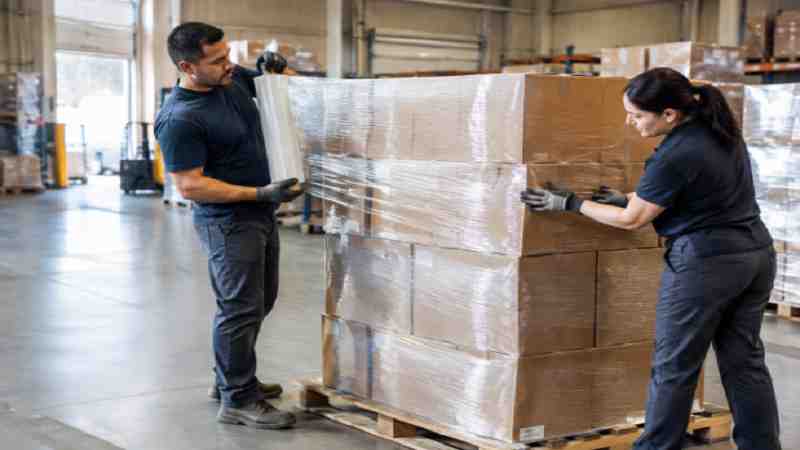
A new hire at a distribution dock grabs the nearest roll, sees clear plastic, and wraps a 2,000-pound pallet of canned goods. Two turns later it’s loose. By the time the truck backs in, the top layer is sagging. Sound familiar? That’s the cling wrap mistake, and it happens more than most managers admit.
Both products are clear. Both stick to themselves. That’s where the match ends.
What material is stretch film made of (LLDPE and how it differs from kitchen-grade plastic wrap)
Industrial pallet wrap stretch film is linear low-density polyethylene (LLDPE), a flexible, thick, tear-resistant plastic. It’s blown or cast into layers that stretch 200% to 300% — then pull back hard, which is what squeezes a load tight. Kitchen-grade wrap is usually a thin PVC or polyethylene film built to cover a bowl, not hold a stack of cartons. Pull a heavy-duty roll and a food wrap roll side by side. You’ll feel the difference in two seconds.
How the cling in cling wrap works compared to the cling on a pallet wrap roll
Cling wrap grabs onto smooth surfaces like glass and ceramic.
Static charge and plasticizers do the work. Stretch film clings differently. It sticks mostly to itself, using a tackifier in the resin, and it relies on stretch tension for its real holding power.
- Cling wrap: sticks to surfaces, low tear strength, no recovery force.
- Pallet film: sticks to itself, high puncture resistance, strong recovery that locks cardboard and corrugated boxes in place.
Stretch Wrap for Pallets: Gauge, Stretch Ratio and Load Hold Explained
Gauge decides how well a wrapped pallet holds.
Stretch ratio decides how far each roll goes. Get both right and the load stays put on the dock, the truck, and the long haul.
Why 60 gauge versus 80 gauge matters on heavy, dense pallets
Think of gauge as film thickness, measured in thousandths of an inch. A 60 gauge clear polyethylene film works fine for light, uniform cartons. But heavy, dense freight is a different story. Corrugated cases of canned goods or bagged material push outward on every turn, and thin film gives up. An 80 gauge roll resists punctures at sharp corners (where most tears start) and keeps tension through a full trip.
- Light, boxed loads: 60 gauge, 3 to 4 wraps at the base.
- Heavy or uneven loads: 80 gauge, 5 to 6 wraps with overlap at the bottom.
- Sharp-edged freight: go thicker, or add corner boards first.
Cheaper film that fails costs more than a better roll. Always.
Hand rolls versus machine rolls and when a pallet wrapping machine pays off
Hand rolls, usually 15 to 18 inch widths on an extended core, suit low volume. Machine rolls run 20 inches and wider, and they pre-stretch the film, so each roll covers more pallets. Wrapping by hand, workers rarely stretch past 15 percent. A machine can hit 200 percent or more.
So when does a pallet wrapping machine make sense? Once you’re wrapping roughly 15 to 20 pallets a shift, the film savings and steadier load hold add up fast.
Where Cling Wrap and Light Plastic Wrap Packaging Fail in the Warehouse
Ever watched a pallet leave your dock wrapped in kitchen-grade film and wondered how long it’d hold? Not long. Cling wrap and other light plastic wrap packaging were built to hug a bowl of leftovers, not to pin 1,800 pounds of boxes together.
Puncture and tear points on corrugated corners and strapped loads
Corrugated corners are the first thing to go. They’re sharp, they flex, and one forklift nudge turns a thin film into confetti. Strapping makes it worse (the edges of the straps bite right through).
Proper pallet wrap stretch film, a thick polyethylene roll with real tear resistance, spreads that stress across the layer. Cling wrap just splits.
Why thin film forces extra wraps and wastes more film per pallet
Here’s what most people miss. Thin film doesn’t save money because crews keep winding to compensate.
- Extra revolutions: 12 to 15 passes with light film, versus 4 to 6 with a heavy-duty stretch wrap.
- Weak containment: film that won’t stretch can’t generate holding force, so loads still lean.
- Rework: a toppled stack means rewrapping, restacking, and a damage claim.
Wasted film is the small loss. A shifted load is the big one.
Choosing Stretch Wrap for Moving, Furniture and Specialty Loads
Roughly 1 in 4 furniture damage claims trace back to scuffed finishes, not crushed frames. Wrong wrap, usually. Warehouse managers who ship sofas, tables, or panel stock on the same film they use for cased goods learn that fast.
Heavy-duty plastic wrap for furniture, flat panels, and insulation board
Furniture needs a thick, clear, flexible film. A 20-inch hand roll in 80 gauge handles upholstery — wood without tearing at the corners. Never wrap bare finished wood directly, since trapped moisture and adhesive-free cling can still mark lacquer. Lay down a layer of paper or a moving blanket first.
Flat loads are different. Foam sheets, insulation board, and plywood slide against each other, so anchor the stack to the pallet with three tight wraps at the base before climbing. Then overlap each pass by half. Heavy-duty stretch wrap on a pallet wrapping machine gives the most even compression, but a good hand roll works for small runs.
When shrink film, strapping or foam corner protection beats plain stretch film
Plain pallet wrap stretch film isn’t always the answer. Pick something else when:
- Shrink film suits outdoor storage, since heat-sealed polyethylene sheds rain.
- Strapping wins for dense, heavy loads like steel or lumber that film can’t hold.
- Foam or cardboard corner boards protect edges so film doesn’t cut into fragile products.
Match the tool to the load. Film alone rarely does everything.
Buying Pallet Wrap Stretch Film: A Direct Checklist for Warehouse Managers
Thicker film isn’t safer film. That’s the myth that fills dumpsters with plastic. Most load failures trace back to bad wrapping technique, not a thin roll.
Matching film to load weight, pallet height, and outbound freight type
Start with the load, not the catalog. A 1,500-lb pallet of boxed goods needs different film than a 400-lb stack of flat corrugated. Run through this list before you reorder:
- Weight: Loads under 1,000 lbs usually hold fine with 60 gauge. Heavier or lumpy loads often call for 80 gauge.
- Height: Past 60 inches, you need more wraps at the top third, where shifts start.
- Freight type: Sharp corners and bagged goods punch through cast film. Go with a tougher blown or high-performance polyethylene roll.
- Method: Handheld rolls are 15 to 20 inches wide. Machine rolls run 30 inches or wider.
Cutting film use per pallet without risking load shifts and damage claims
Pre-stretch is where the savings live.
A pre-stretch machine pulls film 200% to 300% before it touches the load, so one roll covers far more pallets. Hand wrappers rarely stretch past 20%.
So what should you track? Weigh the film on a finished pallet. Then test lighter configurations, and shake-test each one on the dock.
Anchor the first wrap at the base. Lock the film around the pallet itself, not just the cartons. And skip the extra ten turns “for safety” (they rarely add holding force). Fewer, tighter wraps beat a bloated cocoon every time.