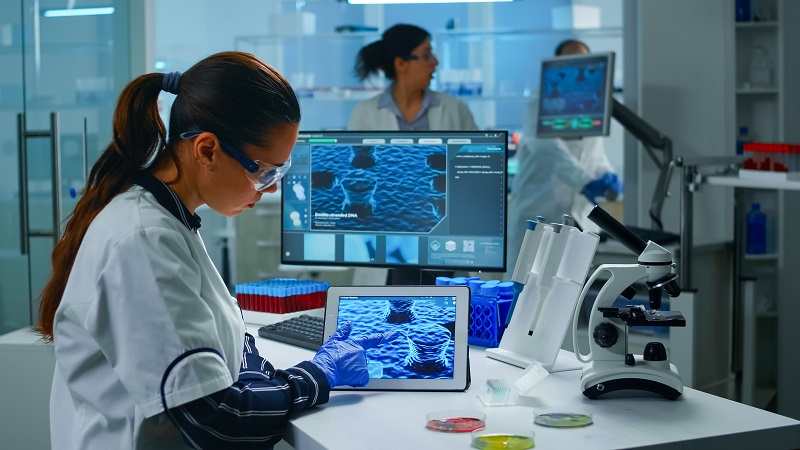
There is a quiet revolution happening inside pathology laboratories across the country, and most patients never see it. While the public conversation around healthcare technology tends to focus on wearables, telehealth, or electronic health records, some of the most consequential changes are taking place at the microscope level. In the labs where tissue samples, biopsy results, and cellular analyses determine the direction of a patient’s entire treatment plan, the tools pathologists rely on are changing fast.
For decades, the workflow inside a pathology lab looked more or less the same. Specimens arrived, were logged by hand or in basic databases, processed through a series of manual steps, and eventually reviewed by a pathologist who would dictate or write a report. The whole process depended heavily on individual attention, institutional memory, and paperwork that moved around the lab in physical folders or basic spreadsheets. It worked, but barely, and only when labs were not overwhelmed with volume.
What Has Changed: Purpose-Built Digital Infrastructure
What has changed is the emergence of purpose-built digital infrastructure for pathology. Not generic hospital software adapted for lab use, but systems designed specifically around how pathology workflows actually function. Laboratory Information Systems, or LIS platforms, have been part of this shift for years. But the generation of LIS software now available is significantly more sophisticated than what labs were using a decade ago. Today’s platforms do not just log specimens. They manage the entire chain of custody, automate routing decisions, flag anomalies, integrate with imaging systems, and generate structured reports that feed directly into broader clinical workflows.
Layered on top of that infrastructure, artificial intelligence is starting to play a genuine role. Not in the science-fiction sense of replacing pathologists, but in the more practical sense of augmenting what pathologists can see and do. AI-assisted image analysis tools can scan whole slide images and highlight regions of concern, helping pathologists prioritize their attention. Machine learning models trained on large datasets of labeled slides can flag potential malignancies, assess tumor margins, or quantify biomarkers with a consistency that human review alone cannot always match, especially at high volume.
The Operational Impact: What Labs Are Experiencing
The combination of a robust LIS platform and AI-assisted analysis tools is fundamentally changing what a pathology lab can accomplish. Labs that once struggled to process a certain volume of cases per day are finding they can handle significantly more without proportional increases in staffing. The most commonly cited improvements include:
- Turnaround times that used to run several days are coming down across lab types
- Error rates associated with manual data entry and mislabeling are declining
- Pathologists can concentrate on diagnostic judgment rather than administrative coordination
- Lab directors have real-time visibility into workflow status that was previously impossible
Patient Safety: The Underemphasized Dimension
The digital transformation happening in pathology is not just about efficiency. There is a patient safety dimension that often gets underemphasized in technology discussions. Diagnostic errors in pathology, including wrong diagnosis, missed findings, and misidentified specimens, are a recognized problem in healthcare. Studies published in peer-reviewed journals have consistently found that diagnostic discordance rates between institutions can be significant, particularly in complex cases.
Better tools do not eliminate that problem, but they create conditions where errors are more likely to be caught. Consider the following scenarios where digital infrastructure adds a layer of protection:
- An LIS that flags a specimen sitting at an unusual stage in the workflow for too long
- An AI model that highlights a region a pathologist might have reviewed quickly but which contains a subtle finding
- Automated critical value alerts that ensure urgent results reach the right clinician without depending on staff memory
The Data Opportunity
Modern pathology labs are generating enormous amounts of data, from slide images that can run into the gigabytes per case, to molecular testing results, to decades of archived case material. That data has clinical value for individual patients, and it has research value when appropriately de-identified and aggregated. Labs that have digitized their workflows are in a fundamentally different position to contribute to research, participate in multi-site studies, and leverage their historical case archives than labs still operating on paper or outdated systems.
Honest Challenges: What Implementation Actually Looks Like
The challenges of digital transformation in pathology are not trivial, and it is worth being honest about that. Implementation of a new LIS is a significant undertaking. It requires buy-in from:
- Pathologists who may have practiced for decades in a certain way
- Lab staff who need to learn new interfaces and revised workflows
- IT teams managing integration with hospital systems, billing platforms, and regulatory reporting
- Lab directors who must sustain throughput during the transition period
Training takes time. Workflow redesign takes time. Labs that have navigated this transition successfully tend to describe a common pattern. The first few months are the hardest. Somewhere around the six-month mark, teams start to find their footing. By the time a lab has been running on a modern platform for a year or more, it often becomes genuinely difficult to imagine going back.
Where the Field Is Heading
Digital pathology and AI-assisted diagnostics are not novelties. They are becoming standard expectations for what a well-run lab looks like. Regulators are paying closer attention to quality management. Accreditation bodies are raising expectations around documentation and audit trails. Payers are demanding more structured reporting. All of these pressures point in the same direction: toward labs that are more digital, more transparent, and better integrated into the broader healthcare system. The labs that are investing in that digital pathology and AInow are building toward a position that will be increasingly difficult to occupy without it in five or ten years.