
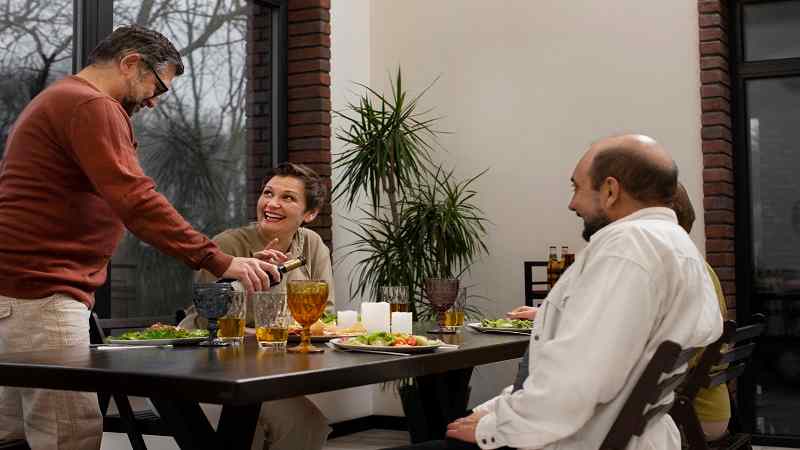
Anticipate the next thing restaurants will start measuring, and seating is a strong candidate. Rooms already track covers, average check, table turn time and section performance. Almost none of them track what the guest is sitting on, even though it is the one variable present for the entire visit and the only one physically touching the customer.
The connection is not mysterious. Commercial restaurant furniture governs how long a body stays willing to remain in one place, and how long somebody stays decides how many courses, rounds and coffees appear on the check. The mechanism is postural rather than psychological, which is why it is measurable and why it will eventually be measured.
The Body Sets a Timer and the Mind Explains It
Start with what actually happens over ninety minutes in a seat.
A chair that supports the thigh, meets the back at a workable angle and does not press behind the knee lets a person sit indefinitely without registering the chair at all. One that fails any of those produces small adjustments, then larger ones, then an impulse to stand.
The guest does not experience that as a chair problem, because nobody thinks about furniture. They experience it as having been there long enough, and they attribute it to the pace of the meal or to a vague sense that it is time to go.
That is the whole effect. The body sets a timer and the mind supplies a reason.
Where the Money Is in the Second Hour
The commercial consequence follows directly from where margin sits on a menu.
A visit’s first hour is the food. The second hour is dessert, coffee, another round, a digestif, and those items carry the highest margin on almost every menu. A room that loses guests at seventy minutes is not losing a fraction of the check, it is losing the profitable part of it.
The National Restaurant Association’s state of the industry work describes a sector where operating margin is thin enough that this distinction decides outcomes. Turning a table quickly is valuable when there is a queue. It is expensive when there is not, and most rooms are not queuing on a Tuesday.
Posture Variety Is What Long Sitting Requires
There is a specific reason booths and benches outperform chairs over long visits, and it is not softness.
A chair supports one posture. A bench supports several: upright, angled, turned sideways, leaning into a corner. Somebody sitting for two hours cycles through all of them without noticing, and the cycling is what prevents the discomfort that ends a visit.
Guidance on seated work published by OSHA is written for offices, and the underlying finding transfers cleanly: sustained sitting needs postural variety more than it needs cushioning. A well-padded chair that permits only one position will lose to a firm bench that permits four.
Noise Ends Meals Faster Than Discomfort Does
The second mechanism is acoustic and it operates faster than the postural one.
A room where the ambient level forces slightly raised voices produces fatigue within about an hour. Guests do not identify it as noise unless it is extreme. They identify it as tiredness, and tiredness ends meals earlier than any other single factor.
Furniture contributes more of that level than operators expect. Chair glides scraping on hard floors sit in the speech frequency range. Hard tops amplify every plate. Bare seat backs reflect where upholstery would absorb, at seated head height. Guidance from the National Institute on Deafness and Other Communication Disorders on noise-induced hearing loss concerns damage rather than dining, and the same measurements explain why a hard room climbs once several tables start competing.
The Boundary Worth Being Careful About
It is worth marking where this argument stops, because it is easy to overstate.
Nothing about a chair determines what somebody chooses to order or how much they should eat. The claim is narrower and more defensible: a comfortable seat removes a reason to leave, and a guest who has not left is available to order again.
That is a claim about opportunity rather than about appetite, and it is the version an operator can actually act on. Everything beyond it belongs to somebody with clinical data, which the furniture trade does not have and should not pretend to.
What a Room Could Actually Measure
Anticipate what this looks like once venues start treating it as data rather than intuition.
Average visit duration by section is already in most point-of-sale systems and almost nobody reads it that way. Compare it against a physical audit of each section: seat type, seat depth, back angle, back-to-back distance, ambient level at peak.
The differences between sections in a single room are frequently larger than the differences between restaurants, and they are attributable to furniture because nothing else varies within one building.
The Audit Worth Running This Month
For an operator who wants evidence rather than a theory:
- Pull average visit duration and average check by section for twelve months
- Record seat type, seat depth and back angle for every section
- Measure back-to-back distance with two people seated and leaning
- Take ambient level readings at peak in each section
- Sit through a full service in the worst-performing section yourself
- Note the minute at which you first want to stand up
The Object Nobody Thinks to Measure
Imagine a restaurant five years from now with seating on the same footing as its equipment schedule. Sections evaluated on revenue per hour of occupancy. Chairs specified against a duration target rather than a look. A quarterly check on glides and adjusters alongside the fryer service.
None of that requires new technology. It requires treating the object the guest spends the entire visit touching as something that affects the business, which is a strange thing to have to argue for and is currently still an argument.
The rooms that get there first will not describe themselves as having better chairs. They will simply have longer visits and larger checks, and the reason will sit under every guest in the building, unremarked on by anybody.