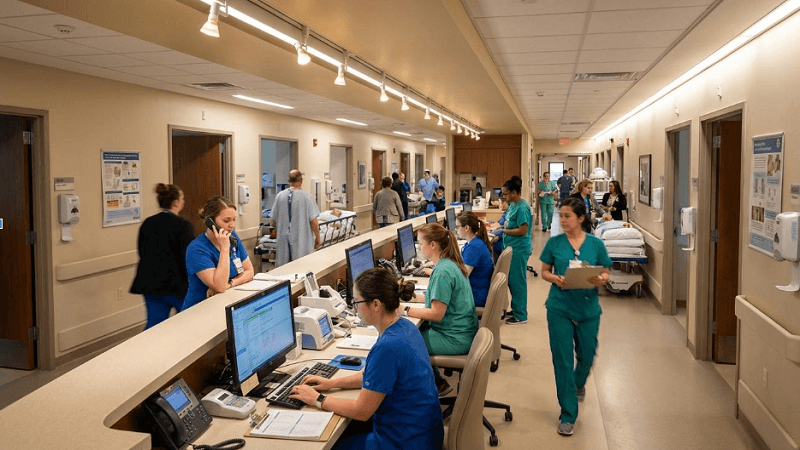
Most patients never see the staffing shortage happening around them. But they feel it — in the wait for a call light to be answered, in the nurse who seems stretched too thin to linger and explain a diagnosis, in the procedure that gets pushed back because there simply aren’t enough hands. What looks like a workforce management problem in a conference room has real, measurable consequences for the people in the beds.
The numbers are stark. According to the HRSA’s December 2025 Nursing Projections Factsheet, the U.S. Bureau of Labor Statistics projects more than 193,000 registered nurse job openings every single year through 2032. The country faces a shortfall of anywhere from 200,000 to 450,000 nurses available for direct patient care — a gap that represents 10 to 20 percent of the entire workforce. That’s not a future problem. It’s a present one, playing out across hospital floors every shift.
This article walks through why the shortage persists, what it means for patients when a floor is understaffed, what new regulations are requiring of hospitals, and how facilities are responding with practical near-term solutions — including flexible staffing approaches that are changing how shift gaps get filled.
Why the Nursing Shortage Keeps Getting Worse
The factors driving the shortage aren’t new — but they’re converging in ways that make the next decade particularly difficult.
Nearly a million registered nurses are projected to retire by 2030, and a large share of the current workforce is already past 50. Retirements alone would strain any system. But the pipeline meant to replace those nurses is blocked at the entry point: more than 65,000 qualified applicants to nursing programs were turned away in the 2024–2025 academic year, not because they weren’t capable, but because nursing schools lacked the faculty and clinical placement capacity to accept them.
Burnout is compounding the attrition. Between 2019 and 2021 — before and during the pandemic — burnout rates among nurses roughly doubled, and tens of thousands left the profession entirely. Many who stayed scaled back hours or moved to administrative and telehealth roles, pulling experienced clinicians away from direct patient care.
Geography adds another layer of disparity. Rural hospitals face a far steeper climb than urban systems, with vacancy rates running well above the national average. For communities already underserved by specialty care, a staffing shortfall isn’t just an inconvenience — it’s a barrier to basic treatment.
The growing demand for nurse practitioners reflects one longer-range response to this gap, expanding the range of advanced practice clinicians who can take on primary and specialty care roles. But training pipelines take years. The shortage exists today.
What Understaffing Actually Does to Patients
When a unit is short-staffed, the effects don’t stay invisible for long — at least not to the people experiencing them.
Research published by the NCBI and the Agency for Healthcare Research and Quality found that each additional patient added to a nurse’s surgical caseload is associated with a 16 percent increase in patient mortality risk. That’s not a marginal finding. It means staffing ratios aren’t just an operational concern — they’re a life-or-death calculation made implicitly every time a charge nurse assigns patients to a short shift.
Beyond mortality, understaffing shows up in subtler ways that patients do notice. Two-thirds of bedside nurses report being unable to complete all essential patient care tasks during their shifts. Discharge planning — the time a nurse spends helping a patient understand medications, follow-up appointments, and warning signs before going home — is often the first thing compressed when a floor is understaffed. Inadequate discharge preparation contributes directly to preventable hospital readmissions.
Infection rates also rise. Multiple studies have documented links between low nurse-to-patient ratios and higher rates of hospital-acquired infections, pressure ulcers, and medication errors. Specialty positions take an average of 49 days to fill, with cardiology and psychiatry vacancies extending beyond six months in some markets. Every day a position sits open, the nurses covering that gap absorb more load.
For patients, the message is simple: how many nurses are working matters to their outcomes, not just their comfort.
Nurse providing attentive care to a patient in a hospital bed
Hospitals Are Now Legally Required to Address Staffing
For years, nurse staffing was treated as an internal operational decision — hospitals and health systems set their own standards with limited external accountability. That changed in January 2026.
The Joint Commission introduced National Performance Goal 12 (NPG 12), which for the first time classifies adequate nurse staffing as a formal national patient safety standard. The requirements are substantive: accredited hospitals must have a nurse executive with a seat at the leadership table, maintain registered nurse coverage around the clock, and demonstrate that staffing levels reflect patient acuity — not just budget targets.
For patients, accreditation status is a meaningful signal. Hospitals that fail Joint Commission standards face consequences tied to quality ratings and, in some cases, reimbursement implications. NPG 12 creates a floor beneath which accredited facilities simply cannot fall without accountability.
The American Nurses Association celebrated the inclusion of staffing in the national performance goals — a milestone the nursing profession had advocated for over many years. The regulatory environment has shifted, and facilities are adjusting accordingly, investing in both structural staffing improvements and faster-response tools that help them meet patient care demands in real time.
How Facilities Are Closing Gaps with Flexible Staffing
Waiting for the nursing education pipeline to produce more graduates is a necessary long-term strategy — but it doesn’t help the floor that’s short two nurses tonight. Hospitals have had to build an operational toolkit for the short term, and that toolkit has evolved considerably.
Travel nurses and agency staffing have long been part of the answer, but both come with significant cost. Travel contracts typically run far above standard nursing wages, and agency overhead can strain already-tight hospital budgets. Mandatory overtime has similar problems: it’s expensive, it accelerates burnout among permanent staff, and it creates the exact coverage-gap cycle facilities are trying to escape. PRN nurses — from the Latin “pro re nata,” meaning “as needed” — represent a more cost-efficient middle ground. These are credentialed clinicians who are available to pick up shifts on demand, already vetted and often already familiar with the facility’s systems and requirements.
PRN shifts typically run 20 to 30 percent below overtime rates, and the savings compound: facilities that reduce overtime reliance can save upward of $5,000 per nurse annually. The speed advantage matters equally. Because PRN clinicians are pre-credentialed, coverage can be secured in hours rather than the 49-plus days that formal recruitment requires.
Hospitals dealing with unpredictable census swings and last-minute call-outs have increasingly turned to a prn shift coverage platform to fill open shifts with pre-vetted, credentialed clinicians — without the overhead of permanent hires or the cost of agency travel contracts. For charge nurses and administrators, having that kind of rapid-fill capability changes how they can respond to short-notice gaps without resorting to mandatory overtime or leaving units understaffed.
Some facilities are also investing in building their own pipeline. Tuition reimbursement programs, partnerships with nursing schools to support faculty capacity, and cohort hiring from accelerated paths into nursing programs are part of a longer-range strategy to reduce dependence on external staffing markets. The two approaches — flexible coverage now, stronger pipeline later — work best in combination.
Questions Patients Can Ask to Protect Themselves
The staffing crisis isn’t something patients can solve, but awareness creates useful leverage. These questions are worth asking, especially when choosing where to receive elective or planned care:
Is this facility Joint Commission-accredited? Joint Commission accreditation signals that a hospital has met external quality and safety standards, including the new NPG 12 staffing requirements effective in 2026.
What are the nurse-to-patient ratios on the unit where I’ll be treated? Some states mandate minimum ratios; in others, facilities set their own. Asking the question invites transparency and signals that you know it matters.
If I encounter PRN or per-diem staff, does that affect my care? The honest answer is: not necessarily. PRN nurses are credentialed professionals. What matters is whether a facility uses them as a supplement to a stable core team or as a structural substitute for adequate permanent staffing — a meaningful distinction worth understanding.
Who is my primary nurse for each shift? In understaffed environments, continuity of care is harder to guarantee. Knowing who is accountable for your care each shift — and making sure handoff communication happens — can reduce the risk that something falls through.
The AHA 2025 Health Care Workforce Scan offers detailed context for patients and caregivers who want to understand the workforce pressures hospitals are operating under right now.
Staffing Is a Patient Safety Issue — And the Response Is Real
The nursing shortage will not resolve itself quickly. Federal projections point to continued shortfall pressure through the 2030s, shaped by demographics, education constraints, and the steady draw of burnout on a workforce already stretched thin. The good news is that the response is no longer passive. New accreditation standards have placed staffing where it belongs — in the category of patient safety, not just hospital operations. Facilities are investing in faster, more flexible coverage models alongside the longer-term work of growing the nursing workforce pipeline.
For patients, the most powerful tool is informed engagement. Asking about staffing ratios, choosing accredited facilities, and understanding how modern coverage models work turns individual patients into an accountability mechanism — one that ultimately pushes institutions toward better care. The shortage is real. So is the momentum to address it.